October 29, 2007
Twins 2007 Minor League Numbers: Hitters
Before I get to the good stuff, please note that these are not my rankings of the Twins' top prospects. That annual list will be published later this offseason and includes both multi-year track records and long-term potential as huge factors, whereas the numbers below focus solely on what each player did this year. The point here is to simply determine who had the best 2007 season by putting everyone's numbers through the same context-adjusting system.
The first step is taking raw numbers and adjusting them for run-scoring environments, with the idea being that everyone should first be placed on an even playing field before evaluating their performance. For example, former first-round pick Chris Parmelee batted just .239/.313/.414 in 128 games at low Single-A, which looks horrible at first glance. However, the Midwest League as a whole batted just .255/.324/.372 while scoring 8.6 combined runs per game in 2007.
The run-scoring environment that Parmelee played in this season was about 12 percent worse for offense than MLB, which is a big part of his underwhelming numbers. Once you normalize the Midwest League to fit the level of offense found in MLB, then Parmelee's hitting line improves to .251/.325/.471. That's still not great, but it's well above average and clearly superior to his raw numbers while better showing the significant power potential that Parmelee (pictured below) possesses.
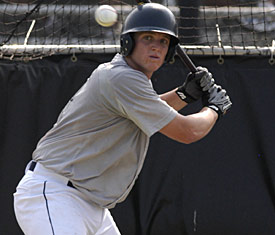 Parmelee slugging just .414 this season is misleading, because he played in a league where hitting for power was exceptionally difficult. Once you account for that his adjusted slugging percentage jumps to .471, which shows him in a completely different light. Because the Twins' minor-league system is filled with teams playing in poor run-scoring environments, normalizing their organization-wide hitting numbers causes nearly every position player to receive a Parmelee-like boost.
Even after those adjustments the Twins still boast one of the weakest collections of hitting prospects in baseball, but as a group their position players weren't nearly as inept as the raw numbers suggest. Putting hitting prospects in leagues where the average team doesn't even slug .400 will do a lot to skew the perception of their ability and that's the case throughout the Twins' system. Once you account for run-scoring environments, here are the top adjusted 2007 hitting lines from Twins minor leaguers:
                       PA      AVG      OBP      SLG      OPS
Deibinson Romero      304     .328     .409     .560     .969
Ozzie Lewis           261     .337     .378     .584     .962
Ben Revere            216     .346     .393     .543     .936
Brian Buscher         431     .316     .388     .540     .928
Rene Leveret          283     .320     .403     .517     .920
Rene Tosoni           297     .314     .411     .478     .889
Brock Peterson        455     .290     .383     .505     .888
Danny Valencia        521     .308     .363     .518     .881
Brian Dinkelman       570     .280     .378     .493     .871
Matthew Macri         357     .298     .348     .519     .867
Erik Lis              539     .281     .340     .519     .859
Wilson Ramos          316     .306     .358     .498     .856
Johnny Woodard        436     .250     .361     .490     .851
Garrett Jones         446     .286     .338     .507     .845
Juan Richardson       220     .337     .368     .472     .840
Garrett Guzman        526     .318     .360     .480     .840
Dustin Martin         552     .298     .368     .470     .838
Luke Hughes           362     .288     .357     .464     .821
Mark Dolenc           265     .299     .384     .436     .820
Darnell McDonald      556     .304     .366     .454     .820
Steven Tolleson       571     .293     .395     .422     .817
Rashad Eldridge       407     .297     .361     .455     .816
Matt Tolbert          477     .300     .357     .457     .814
Jose Morales          411     .318     .370     .427     .797
Chris Parmelee        501     .251     .325     .471     .796
Juan Portes           552     .276     .342     .453     .795
Yangervis Solarte     203     .322     .346     .444     .790
Tommy Watkins         402     .278     .353     .433     .786
Joe Benson            507     .268     .360     .418     .778
Jeanfred Brito        229     .308     .333     .443     .776
Plenty of the organization's hitting prospects had solid seasons at the plate, although five of the top six came from rookie-ball players who batted under 300 times. Even adjusted, those numbers are the product of a small sample of playing time and should also be taken with a grain of salt for another reason that I'll get into momentarily. Among players who batted at least 400 times, Brian Buscher put together the best season with an adjusted hitting line of .316/.388/.540 between Double-A and Triple-A.
The trio of rookie-ball hitters whose seasons ranked above Buscher--Deibinson Romero, Ozzie Lewis, and Ben Revere--show the importance of the next step, which is making further adjustments for age and defensive position. In other words, how does each player's offense compare to other players at his position and how old was each player relative to the prospects he was playing against. If you take the normalized numbers above and apply further adjustments based on age and position, you get:
                      AGE     LEVEL     POS     OPS%
Wilson Ramos           19     A-          C     1.31
Deibinson Romero       20     RK/A-      3B     1.23
Ben Revere             19     RK         CF     1.22
Jose Morales           24     AAA         C     1.20
Trevor Plouffe         21     AA         SS     1.17
Luke Hughes            22     AA         2B     1.15
Brock Peterson         23     AA         1B     1.13
Joe Benson             19     A-         CF     1.13
Brian Buscher          26     AA/AAA     3B     1.12
Danny Valencia         22     A-/A+      3B     1.11
Matt Tolbert           25     AAA        2B     1.11
Alexi Casilla          22     AAA        2B     1.11
Chris Parmelee         19     A-         RF     1.10
Matthew Macri          25     AA/AAA     3B     1.10
Rene Tosoni            20     RK/A-      RF     1.10
Brian Dinkelman        23     A-/A+      2B     1.09
Ozzie Lewis            21     RK         LF     1.08
Brandon Roberts        22     AA         CF     1.07
David Winfree          21     AA         1B     1.07
Steven Tolleson        23     A+         SS     1.07
Garrett Guzman         24     AA         LF     1.05
Juan Portes            21     A+         3B     1.05
Johnny Woodard         22     A-/A+      1B     1.05
Garrett Jones          26     AAA        LF     1.05
Dustin Martin          23     A+         CF     1.04
Denard Span            23     AAA        CF     1.04
Erik Lis               23     A+         LF     1.02
Tommy Watkins          27     AAA        SS     1.02
Jeanfred Brito         19     RK         2B     1.02
Rashad Eldridge        25     AA         CF     1.02
Shown above is a player's age this season, which level(s) he played at, which position he primarily manned, and how his context-adjusted offense compared to "average." For instance, Parmelee was 19 years old, spent the entire season at low Single-A, played primarily right field, and was about 10 percent above average offensively once everything was taken into account. The first list took only offense and run-scoring environment into account, while this list also factored in age and position.
The two rankings are very different and a look at the aforementioned rookie-ball trio of Romero, Lewis, and Revere helps shows why. All three players posted an adjusted OPS above .900 while playing at rookie-ball, but Romero and Revere stay at the top of the second list while Lewis drops from second to 17th. The reason for that is two-fold, with the first being that Lewis split time between left field and designated hitter, while Revere (pictured below) manned center field and Romero played third base.
 The further down the "defensive spectrum" that a player moves, the less impressive that his hitting becomes relative to other players at his position. In other words, a .900 OPS is much better coming from a shortstop than a first baseman. Lewis is essentially at the bottom of the defensive spectrum, while Revere is at the top and Romero is in the middle. Toss in their projected defensive value and it's easy to see why Lewis' .900 OPS doesn't look quite as impressive as it did initially.
Beyond that, Revere and Romero both joined the Twins' system without playing college ball and played this season at 19 and 20 years old, respectively. Meanwhile, Lewis played three years at Fresno State before being drafted and was 21 years old this season. The difference between 19, 20, and 21 may not seem like much, but even one year is huge when it comes to projecting player development and evaluating someone's performance in the low minors.
Plenty of 21-years-olds who're drafted out of college thrive at rookie-ball, in large part because they're older and have more high-level experience than most of the players they're competing against. Plus, the Twins have several 21-year-olds already at Double-A. On the surface Romero, Lewis, and Revere had similar seasons offensively, but dig a little deeper and you can see that Lewis' year wasn't on the same level. The same logic also holds true beyond rookie-ball, although perhaps to a lesser extent.
Based purely on offense Garrett Jones had the 14th-best season of any hitter in the Twins' system, but he was also a 26-year-old playing his third season at Triple-A and was limited to first base or an outfield corner defensively. Once you take Jones' normalized numbers and adjust them further for his age and position, he drops to 24th on the list. While guys like Lewis and Jones move down on the second list, up-the-middle defenders who were young for their leagues move up.
In particular, adjusting for age and position pushes Wilson Ramos into the top spot after ranking 12th on the offense-only list. Ramos batted .291/.345/.438 at low Single-A, which works out to an adjusted hitting line of .306/.358/.498. That nice line gets even nicer when you consider that Ramos was a 19-year-old catcher. An .856 OPS from anyone is good, but an .856 OPS from a teenager manning arguably the most important defensive position while playing in a full-season league is fantastic.
Once you account for the run-scoring environment that he played in and adjust for both position and age, Ramos' 2007 season was about 31 percent above average offensively. That's an amazing year for a prospect who many observers think can potentially be a tremendous defensive catcher and Ramos leads the way among a total of 30 Twins minor leaguers who were above average offensively while batting at least 200 times.
Among hitters who came to the plate at least 400 times, Triple-A Rochester's Jose Morales--last seen suffering a gruesome ankle injury during a call-up with the Twins--was best at around 20 percent above average thanks to being a 24-year-old catcher with a .318/.370/.427 adjusted hitting line. Also having strong context-adjusted seasons in 400-plus plate appearances were Trevor Plouffe, Brock Peterson, Joe Benson, Danny Valencia, Matt Tolbert, Parmelee, and Buscher.
Once you're done here, check out my latest "Daily Dose" column over at Rotoworld.