June 19, 2013
Who are the best young hitters in Twins history?
Oswaldo Arcia has thrived as a 22-year-old rookie, Aaron Hicks has struggled as a 23-year-old rookie, and Twins fans are counting down the days until stud prospects Miguel Sano and Byron Buxton arrive in Minnesota. All of which got me thinking about the best young hitters in Twins history, so I looked up the most productive seasons for each age based on OPS. No teenage hitter has even gotten regular playing time for the Twins, so let's start with 20-year-olds ...
AGE 20              YEAR      PA      OPS
Butch Wynegar       1976     622     .719
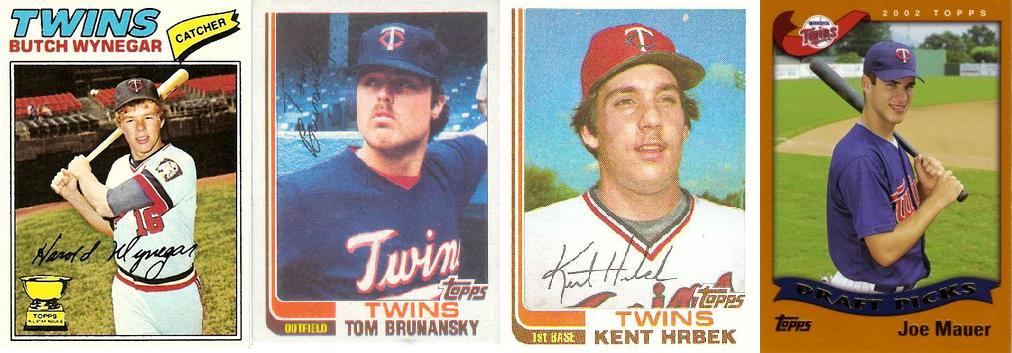
Butch Wynegar is the only hitter in Twins history to see regular action at age 20 and he logged 622 plate appearances, started 133 games at catcher, threw out 35 percent of steal attempts, and made the All-Star team while hitting .260/.356/.363 with more walks (79) than strikeouts (63) in a pitcher-friendly era. Adjusting for the time it was a Joe Mauer-esque year, which is why he was such a phenom and why, despite a solid 13-year career, he was ultimately a disappointment.
Bert Blyleven actually has the second-most plate appearances by a 20-year-old in Twins history with 100, because he was an amazing young pitcher who debuted before the designated hitter. In fact, he also has the most plate appearances by a 19-year-old in Twins history with 58. Through age 20 he hit .135 in 158 trips to the plate ... and tossed 442 innings with a 2.95 ERA. Blyleven ended up with 514 career plate appearances and hit .131 with a 193-to-5 strikeout-to-walk ratio.
Among position players Luis Rivas has the second-most plate appearances by a 20-year-old in Twins history with 64. In the early days of this blog the Twins rushing Rivas to the majors and repeatedly handing him a starting job based almost solely on his age was a frequent source of frustration. He debuted at 20 and got the sixth-most plate appearances in team history through age 24--Wynegar got the most by a wide margin--but Rivas basically never improved.
AGE 21              YEAR      PA      OPS
Tom Brunansky       1982     545     .848
Rod Carew           1967     561     .750
Butch Wynegar       1977     617     .715
Zoilo Versalles     1961     542     .704
Luis Rivas          2001     619     .682
Cristian Guzman     1999     456     .543
Those are the only six 21-year-olds in Twins history to log at least 300 plate appearances. Tom Brunansky actually began that 1982 season at Triple-A in the Angels organization and was hitting just .205/.317/.330 in 25 games there when they traded him to the Twins in mid-May along with Mike Walters for Doug Corbett and Rob Wilfong. He was immediately handed a starting job and hit .272/.377/.471 with 20 homers, 30 doubles, and 71 walks in 127 games.
Rod Carew was also no slouch at 21, hitting .292/.341/.409 in one of the lowest-scoring eras in baseball history. Seriously, in 1967 the American League as a whole hit .236 with a .303 on-base percentage and .351 slugging percentage. If you adjust Carew's raw numbers to today's offensive environment he hit around .315/.360/.475, which is amazing from a 21-year-old second baseman and explains how he missed being the unanimous Rookie of the Year winner by one vote.
Wynegar cracks the list again and Rivas shows up too, along with shortstops Zoilo Versalles and Cristian Guzman. In six decades of Twins history only two regulars have been above-average hitters at 21, which is something to remember when Sano and Buxton show up. Mauer doesn't make the age-21 list because a knee injury cut short his rookie season, but he hit .308/.369/.570 in 122 plate appearances for what would be the top OPS by a wide margin.
AGE 22              YEAR      PA      OPS
Kent Hrbek          1982     591     .848
David Ortiz         1998     326     .817
Joe Mauer           2005     554     .783
Oswaldo Arcia       2013     133     .759
Tom Brunansky       1983     611     .753
I've included Arcia on the age-22 list despite his not having enough plate appearances to qualify yet because he's actually what got me thinking about this topic in the first place. Arcia has fared well enough in the early going that I wondered how his production compares to other 22-year-old Twins, discovering that he's in some pretty nice company with Kent Hrbek, David Ortiz, Mauer, and Brunansky.
In all a total of 12 different Twins have gotten at least 300 plate appearances at age 22 and Hrbek leads the way by hitting .301/.363/.485 with 23 homers in 140 games as a rookie in 1981. The worst OPS in the group of 22-year-olds belongs to Wynegar, who fell to .229/.307/.308 in his third season after being an All-Star at 20 and 21. Rivas, Guzman, Versalles, Carew, and Carlos Gomez also posted a sub-.700 OPS at 22.
AGE 23              YEAR      PA      OPS
Joe Mauer           2006     608     .936
Justin Morneau      2004     312     .875
Kent Hrbek          1983     582     .855
Rod Carew           1969     504     .853
Cristian Guzman     2001     527     .811
Four of the truly elite hitters in Twins history ... and Guzman. He'd been terrible in his first two seasons with the Twins, but in 2001 he hit .308/.346/.507 with seven homers, 22 doubles, and an incredible 13 triples in the first half to make the All-Star team. And then just as everyone was getting excited about a switch-hitting 23-year-old shortstop emerging as a star Guzman hurt his shoulder, missed much of the second half, and resumed being a terrible hitter.
Mauer hit .347/.429/.507 in 140 games at age 23, becoming the first catcher in AL history to win a batting title. He likely should have finished either first or second in the MVP voting, but instead placed sixth while teammate Justin Morneau won the award based largely on racking up RBIs with Mauer on base in front of him. Two years earlier Morneau posted the second-best OPS by a 23-year-old in Twins history, hitting .271/.340/.536 in 74 games after a midseason call-up.
Carew, like Mauer, won his first batting title at age 23, hitting .332/.386/.467 in 1969 to boost his OPS by 200 points compared to 1968, which happened to be one of the lowest-scoring seasons in baseball history and the final season before MLB lowered the pitching mound. In all 28 different Twins have gotten at least 300 plate appearances at age 23 and 13 failed to crack a .700 OPS, including Torii Hunter and Roy Smalley.
Hicks hasn't reached 300 plate appearances yet, but his current .575 OPS at age 23 would rank third-worst ahead of only David McCarty (.542) and Danny Thompson (.482). Greg Gagne (.596) and Rich Becker (.599) also aren't very far ahead of Hicks and two guys who preceded him in center field, Gomez and Ben Revere, posted an OPS under .625 at 23. Next season Arcia will try to become the sixth Twins hitter to crack an .800 OPS at 23.
AGE 24              YEAR      PA      OPS
Kent Hrbek          1984     635     .906
Delmon Young        2010     613     .826
Denard Span         2008     411     .819
David Ortiz         2000     478     .810
Joe Mauer           2007     471     .808
Hrbek has the best OPS for 22-year-olds, the third-best OPS for 23-year-olds, and the best OPS for 24-year-olds. In his age-24 season listed above he hit .311/.383/.522 with 27 homers in 149 games, finishing runner-up in the MVP voting behind Tigers reliever Willie Hernandez despite not even making the All-Star team. Hrbek never finished in the top 15 in MVP voting before or after that season, although he had plenty of other productive years.
Delmon Young appeared to have a breakout season in 2010, hitting .298/.333/.493 with 21 homers and 46 doubles in 153 games at age 24 to convince a lot of people he was finally living up to the hype he received as a prospect. He finished 10th in the MVP balloting because some voters overlooked his terrible defense and focused on his high RBI total, but in three seasons since then he's hit just .263/.297/.404.
Ortiz has the second-best OPS for 22-year-olds and the fourth-best OPS for 24-year-olds, so while no one could have predicted that he'd become one of the elite hitters in baseball after leaving the Twins there was certainly plenty of promise shown at a young age. In all Ortiz hit .266/.348/.461 in 455 games for the Twins through age 25. In team history only Mauer, Hrbek, Morneau, and Rich Rollins had more plate appearances and a higher OPS than Ortiz through age 25.
By age 24 plenty of hitters are regulars in the majors and a total of 38 different Twins hitters got at least 300 plate appearances as 24-year-olds. Kirby Puckett ranks 34th out of 38 with a .655 OPS, hitting .296/.320/.336 with zero homers in 128 games as a rookie. Carew would hold the top spot among 24-year-olds with a .930 OPS in 1970, but a knee injury ended his season after 51 games with a .366 batting average.
AGE 25              YEAR      PA      OPS
Harmon Killebrew    1961     656    1.012
Justin Morneau      2006     661     .934
Tony Oliva          1964     719     .916
Bobby Kielty        2002     348     .890
Joe Mauer           2008     633     .864
Harmon Killebrew couldn't crack any of these lists before age 25 because the team didn't move to Minnesota until then. In his first Twins season Killebrew hit .288/.405/.606 with 46 homers and 107 walks. Five decades later he's still the only Twins hitter to top a .950 OPS by age 25. Tony Oliva also cracks these lists for the first time at 25 because it was his rookie season. He led the AL in batting average, runs, doubles, and total bases, winning Rookie of the Year.
Morneau's aforementioned MVP-winning 2006 season came at age 25, as he hit .321/.375/.556 with 34 homers and 37 doubles in 159 games. Morneau has the second-best OPS for 23-year-olds and 25-year-olds, but hit just .239/.304/.437 in between as a 24-year-old. Mauer cracks the top five in OPS for ages 22, 23, 24, and 25. And he likely would've had the top OPS for 21-year-olds too if not for the knee injury.
Bobby Kielty is the odd man out on the age-25 list, which reminds me that I've never been more wrong about a player. He was a switch-hitting outfielder with power and plate discipline, and as you can see Kielty put up big numbers at an early age. When the Twins traded Kielty to the Blue Jays for Shannon Stewart in 2006 he was a 26-year-old .269/.375/.444 hitter. I thought they'd made a terrible mistake. And then Kielty hit .246/.333/.389 after the trade, flaming out at 30.
Interested in sponsoring a week of AG.com and advertising your product, service, local business, or website directly to thousands of readers each day? Click here for details.